
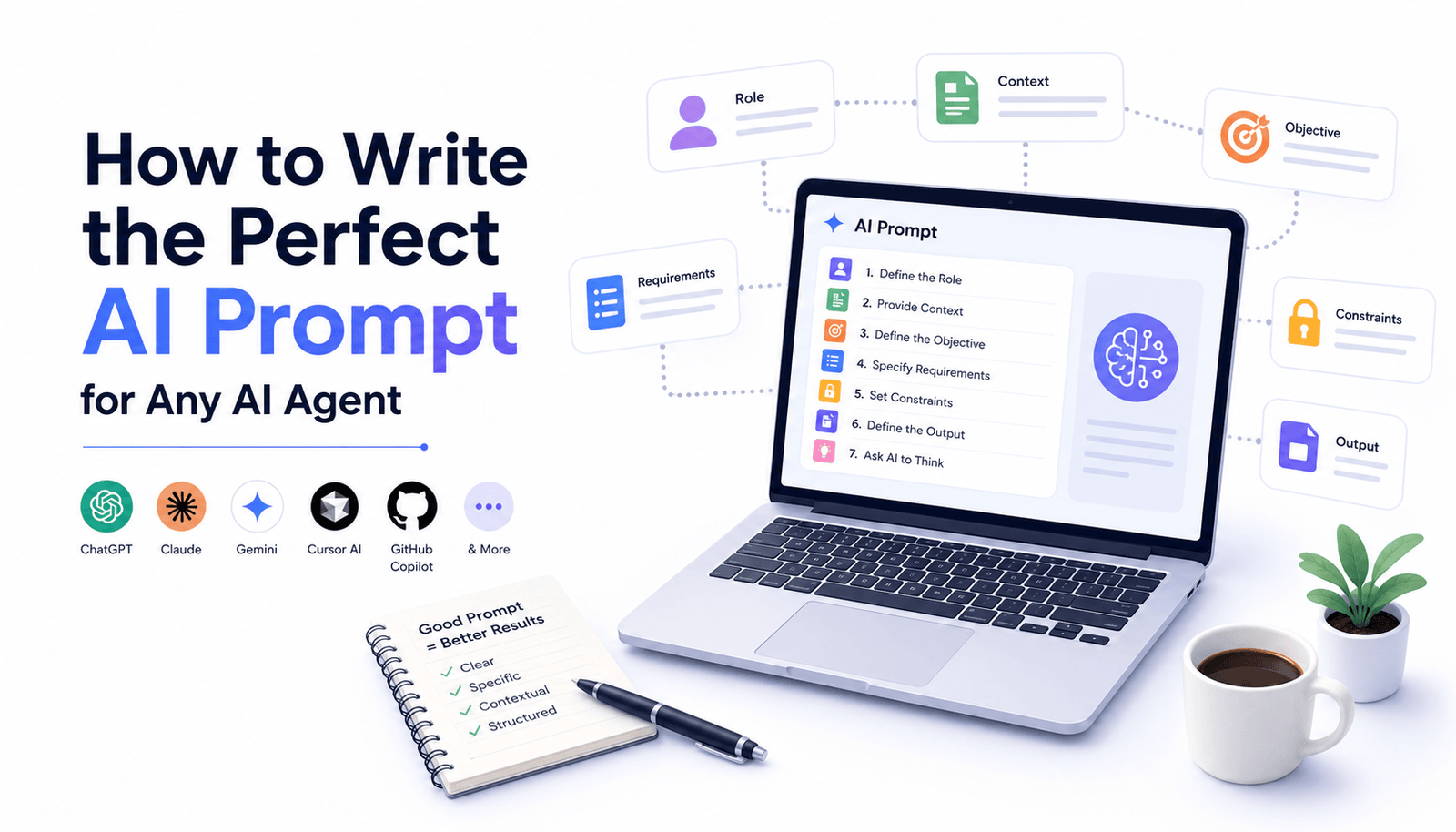
How to Write the Perfect AI Prompt for Any AI Agent (2026 Complete Guide)
Artificial Intelligence has transformed the way we work. From writing code and generating content to designing user interfaces and automating workflows, AI agents have become an essential part of every developer's toolkit.
However, one question remains common:
Why does AI sometimes give amazing results and other times produce disappointing answers?
The answer is surprisingly simple—your prompt.
A well-crafted prompt acts as a technical specification for the AI, helping it understand your goals, constraints, and expectations. In this guide, you'll learn how to write prompts that consistently produce professional, accurate, and high-quality results.
What Is Prompt Engineering?
Prompt engineering is the practice of creating structured instructions that guide AI models toward producing better responses.
Instead of asking vague questions, you provide context, define objectives, specify constraints, and clearly describe the expected output.
Think of it like writing requirements for a software project—the clearer the requirements, the better the final product.
Why Good Prompts Matter
A good prompt can help AI:
- Produce more accurate answers
- Generate production-ready code
- Reduce unnecessary follow-up questions
- Improve consistency
- Follow project standards
- Save hours of editing
Poor prompts often lead to generic or incomplete responses.
The Professional Prompt Framework
The following framework works well with ChatGPT, Claude, Gemini, Cursor AI, GitHub Copilot, OpenAI Codex, and many other AI assistants.
1. Assign a Role
Tell the AI who it should act as.
Example:
You are a Senior Software Architect with over 10 years of experience building enterprise applications.
2. Explain the Project
Provide background information.
Example:
Project:
Hisab Kitab is an AI-powered expense tracking application built using React Native Expo, Supabase, SQLite, RevenueCat, and TypeScript.
3. Define the Objective
Clearly describe what you want.
Instead of:
Build login page.
Write:
Design and implement a secure authentication system with email login, Google Sign-In, Apple Sign-In, password reset, session management, and enterprise-grade security.
4. Specify the Technology Stack
Never make the AI guess.
Example:
- React Native Expo
- TypeScript
- Supabase
- PostgreSQL
- React Hook Form
- Zod
- Zustand
5. Mention Constraints
Include any important limitations.
Examples:
- Use TypeScript only
- Avoid unnecessary libraries
- Follow Clean Architecture
- Mobile-first design
- Enterprise-ready code
- Performance optimized
6. Define Coding Standards
Ask AI to follow specific standards.
Example:
- SOLID Principles
- DRY
- Clean Code
- Error Handling
- Accessibility
- Reusable Components
- Unit-Test Friendly
7. Describe the Expected Output
Tell AI exactly what to deliver.
Example:
- Architecture Overview
- Folder Structure
- Database Design
- API Endpoints
- Type Definitions
- Components
- Complete Source Code
- Security Recommendations
- Performance Optimizations
- Documentation
8. Ask AI to Think Before Answering
This often improves the quality of the response.
Example:
Before generating the solution:
- Analyze the requirements
- Identify edge cases
- Suggest improvements
- Explain the approach
- Generate the implementation
A Reusable Prompt Template
You are an experienced [ROLE].Project Overview
<Project description>
Technology Stack
<List technologies>
Objective
<Describe the task>
Requirements
- Requirement 1
- Requirement 2
- Requirement 3
Constraints
- Enterprise-ready
- Performance optimized
- Secure
- Scalable
Coding Standards
- SOLID
- DRY
- Clean Architecture
- TypeScript
- Error Handling
Expected Output
- Architecture
- Folder Structure
- Database Schema
- APIs
- Complete Code
- Documentation
Before answering:
- Analyze requirements
- Suggest improvements
- Explain your reasoning
- Generate the final solution
Common Prompt Mistakes
Avoid these common mistakes:
❌ Giving little or no context
❌ Not specifying the technology stack
❌ Asking multiple unrelated questions
❌ Ignoring security requirements
❌ Forgetting performance expectations
❌ Not defining the expected output
❌ Requesting "best solution" without explaining the problem
Best Practices
Be Specific
The more information you provide, the better the AI can help.
Break Large Problems into Smaller Tasks
Instead of asking AI to build an entire application, ask it to complete one feature at a time.
Encourage Questions
Allow AI to ask for clarification when requirements are unclear.
Ask for Alternatives
Request multiple solutions along with their pros and cons.
Review the Output
Always validate AI-generated content before using it in production.
Example: Poor Prompt vs Great Prompt
Poor Prompt
Create login page.
Great Prompt
You are a Senior React Native Architect.Project:
Hisab Kitab is an AI-powered finance application built with Expo, Supabase, SQLite, RevenueCat, and TypeScript.
Task:
Design a secure authentication system.
Requirements:
- Email login
- Google Sign-In
- Apple Sign-In
- Password reset
- Multi-device session management
- Secure token storage
- Offline support
- Loading and error states
- Accessibility
Deliver:
- Architecture
- Folder Structure
- Database
- APIs
- Components
- Complete implementation
- Security review
Final Thoughts
Prompt engineering is becoming one of the most valuable skills in the AI era. Whether you're writing code, creating content, designing products, or analyzing data, a well-structured prompt can dramatically improve the quality of AI-generated results.
Treat your prompts like project specifications—clear, detailed, and purposeful. The time you invest in crafting better prompts will save countless hours of revisions and produce more reliable outcomes.
Frequently Asked Questions
What is prompt engineering?
Prompt engineering is the process of designing effective instructions that help AI models generate accurate and useful responses.
Do all AI models benefit from structured prompts?
Yes. Structured prompts improve the quality of responses across most modern AI assistants.
Should I always mention my technology stack?
Absolutely. Providing your framework, language, and libraries helps AI generate more relevant solutions.
Can better prompts improve coding results?
Yes. Better prompts typically lead to cleaner architecture, fewer bugs, and more maintainable code.
Is prompt engineering difficult to learn?
Not at all. By following a consistent framework and practicing regularly, anyone can write effective prompts.
Keywords: Prompt Engineering, AI Prompts, ChatGPT, Claude, Gemini, Cursor AI, GitHub Copilot, AI Agents, Software Development, Artificial Intelligence